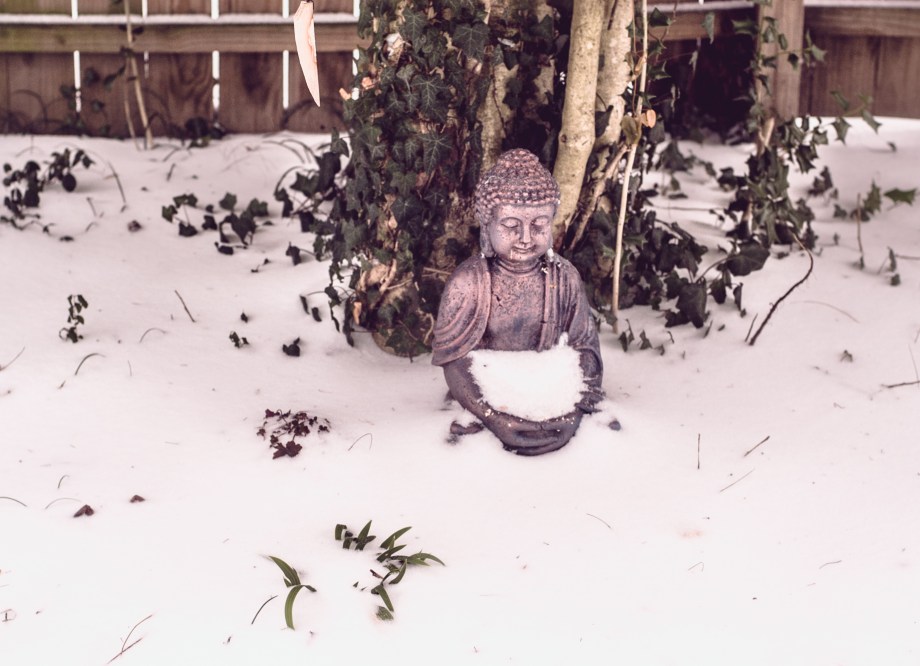
The temperature here keeps fluctuating between “dead of winter” cold to a hint of warmth signalling early spring. Yesterday, I noticed the forecast calling for mixed rain and snow tonight, and possibly snow next week. I see no sign of this in the sunshine floating through my home office window at the moment, although today’s temp is lower than yesterday’s, and the tile office floor may as well be as slick as the ice it resembles.
Cold and winter pose serious problems for a girl from south Louisiana who’s suffered from chronic depression all her life. Between the freezing temperatures and the early dark and the dead and dormant plants littering my yard, head-sickness is even more difficult to handle. This is the time of year when I have to make a clear effort to move more than usual, to take more than my normal amount of exercise, but end up returning home from work each day only to crawl into bed for a nice, long nap — or at least, curl up in bed with a nice, long book. Beneath the pile of blankets, dreaming or reading, I can hide from the world — and our current weather, combined with my current head space, calls for that kind of hibernation.
This would be all well and good if it helped my serotonin levels, but hibernating only makes it worse. I nap or read in bed and feel guilty about all the things I should be doing and am not. The south Louisiana heat was never much of an improvement on that, if I’m being honest. Weather does not determine chemical imbalances, although winter poses more of a menace to my mental load than heat and humidity. At least in heat and humidity, I can get outside and dig in my garden dirt, a coping mechanism that works when I can drag myself out to do it.
And that’s not to say that it never got cold, or never gets cold, back home. It does, although it doesn’t linger as long as the winters here in North Carolina. I remember Arctic freezes swinging low on a meteorologist’s weather map, the choppy snows we’d get every few years, seeing my breath roll visibly from my mouth while standing outside waiting for the school bus in a puffy jacket that saw daylight only a few times a year.
I grew up in an old family home — somewhere close to a century old — that could hold cold or heat close and tight without letting go for weeks. Although it had been fitted with modern attic insulation at some point, in the winter, the temperature inside the house ran neck and neck with the temperature outside. Sitting in my bedroom as a teenager, wrapped in an electric blanket, I could literally see my breath as I listened to music and wrote in my journal or read or flipped through magazines. In the summer, it was a virtual sauna. I remember summers when the windows were open for weeks, and you’d fight to sit in front of a fan and stay there as long as possible, because moving one step could start a fit of sweating. It was so hot in the house that you sometimes had to go outside to escape, as it could be cooler out there, especially if there was a strong Gulf wind blowing in or a nice breeze floating in off the Mermentau River, which ran directly in front of my house.
The winter didn’t make anything better. When you live in nearly year-round 100 percent humidity, this doesn’t help when it’s cold; in fact, high humidity makes the air feel colder, heavier, more stickier-to-your-bones. But we would get some legitimate freezing on occasion, and the pipes under the house would burst if you didn’t leave the faucets dripping at night, and my dad would spend mornings under the house swearing and grunting to fix the plumbing with money we didn’t have.
This home was not a huge house, but not small either, and although my dad inherited it, and we had the land it sat on and surrounded it, he made barely enough money to keep it up or to keep it heated through winter and cooled in the summer. My mom kept a close eye on the thermostat, even if the heating and cooling units were rarely turned on. You had to deal with it and remember how lucky we were to have a roof over our heads without a mortgage or rent payment.
We moved into that house the year I turned 11, not long after my great-uncle T.A., who helped raised me, who I adored, who I still think of regularly, shot himself in the chest. He lived there before us, and before him, my great-grandparents. My dad lived with them instead of his mother on and off well into adolescence, before he and my mother married when they were 18 and 16 years old, respectively. I spent most of my childhood there with T.A. and my grandmother, his sister. They were so close that people often thought they were married and not siblings. My grandmother stayed at the old house most days, as her second husband, my step-grandfather, worked as a boat captain for offshore oil companies and was regularly away from their home. T.A. was an old bachelor, and the three of us became a tight family unit. I loved being there with them. Moments of being in that house with them are some of the best moments of my childhood.
But T.A. shot himself on January 17, 1988, four days before my birthday. Afterward, our family moved in. Although I had always loved the old house, I didn’t want to live there. I was sad to leave our own double-wide trailer, with the big front porch my dad had built on the front and the nice patio my mom had created off the back. And if T.A. wasn’t there, I certainly didn’t want to be there, either. Nor did I want to venture into the backyard, where my grandmother and I returned home from church on the not-so-cold January morning to find him with a hole in his chest and strychnine in his pocket, should the gun not do the work.
It snowed later in the winter of 1988 — in late February, if I’m remembering it correctly. Louisiana snow is not the fluffy, powdery snow you see on television and in still photographs taken in places like Colorado. Louisiana snow is more like a high-school love affair: temporary and mushy. My cousins and sister and I would get a snow day or two off from school, and we’d run around plopping what were ostensibly rain boots through the sloppy mush, building what I now recognize as pretty pathetic snowmen. My mom would either be home from work or not working at various points; in the winter of 1988, my little brother Matt was only about seven months old, so she was home taking care of him. Once we saw the white wonderland we’d never see often and beg to play in it, she would bundle us up, send us out, and call us back in again before we could stay out long enough to contract pneumonia in the humidity-heavy mess that amazed us as native swamp and marsh kids.
While we were out, she’d build a fire in the fireplace of the old living room and, once we were in, she’d strip us down, give us new clothes, sit us around the fireplace. The old gas heater in the den might be running, and the pilots on the stove to heat at least a portion of the house. Mom would put on a kettle of water to make hot chocolate, something she did as a special treat on the occasional cold mornings before school anyway, but felt more fitting to drink after tromping around outside in “real” winter weather. I remember thinking that it felt like this is what people who lived in regularly snowy places did. They sat around fireplaces with blankets over their shoulders and heavy socks on their feet, drinking packet hot chocolate made with boiling water and some marshmallows thrown in for good measure.
Those days had a silent balm to them, something different and special and quiet. My mind would stay still for minute, numbed by a cold that was rare in our part of the world. That winter, it needed to be still for more than a minute. That day, sitting in front of the fireplace with my cousins and sister, hardly a month after T.A. died, I felt a confusion and anger that lived in me well into my 20s, feelings that shifted and buried themselves beyond that, feelings that I’ve only been able to sort of resolve, in my late 30s, by forgiving him and letting it go. I thought about those feelings, that forgiveness, that winter, and that great uncle, as I walked to my car a few Mondays ago, having heard that a student in one of my classes committed suicide over the weekend. Feeling the grief of her classmates, watching them motion quietly to me during lecture, with tears in their eyes, signaling that they couldn’t sit in class any longer. Me nodding back, a silent gesture of my approval and sympathy. Afterward, walking back to my car through a crust of icy snow left over from a weekend storm, hoping that, if anything, the cold might freeze their tears in more ways than one.
 the malarkey bin
2 thoughts on “Different and Special and Quiet”